|
Holy Week is a week-long series of services that honor Jesus Christ's sacrifice on the Cross and his resurrection. We call this the Paschal Mystery, that through his death and resurrection, evil was destroyed and creation set free. Holy Week is the most important, most sacred time of the year for Christians.
The Schedule of Holy Week liturgies
|
The heart of the Christian mystery is this:
Christ has died. Christ is risen. Christ will come again. We celebrate Christ's mighty acts of salvation in this Holy Week. Come to all the services that you can. If you cannot come to all, then make a special effort to attend the evening of Good Friday, and the Great Vigil. Learn about the Holy Week services below. |
Palm Sunday
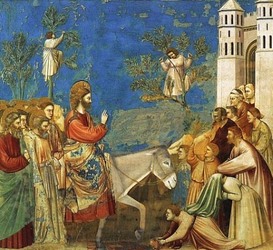
The title of this day is technically The Sunday of the Passion: Palm Sunday. In one worship service, we really remember two events. The first is the entry of Our Lord into Jerusalem, when people cheered and rejoiced. The second is the Crucifixion of Our Lord at the end of that week. It's a painful time, taking us from high to low, from "Hosanna" to "crucify him". The liturgy begins with a blessing of palm branches, which the faithful can take home with them and put in a place of honor in their homes. The Passion Gospel is read, which is the first time this week we hear the story of Christ's betrayal and crucifixion.
Tenebrae
Tenebrae is Latin for "shadows". It is the old monastic daily prayer for certain of the days in Holy Week, combined into a single, fairly lengthy service. We say or sing psalms, and we hear portions of the book of Lamentations, the writings of St. Augustine of Hippo, and the epistles.
The most distinctive feature of the service is the hearse, which is a special candlebra that holds 15 candles. After each psalm, a candle is snuffed out until only one remains. Tenebrae takes us into a reflective and solemn mood. The gathering forces of darkness drew in towards Jesus before his arrest. There are still forces of darkness in our lives today.
The most distinctive feature of the service is the hearse, which is a special candlebra that holds 15 candles. After each psalm, a candle is snuffed out until only one remains. Tenebrae takes us into a reflective and solemn mood. The gathering forces of darkness drew in towards Jesus before his arrest. There are still forces of darkness in our lives today.
Maundy Thursday
The Evening Mass of the Lord's Supper happens tonight, Maundy Thursday. This is the night when we celebrate the Last Supper, which is the institution of the Holy Eucharist.
On that night, according to St. John, Jesus washed the feet of his disciples, saying "a new commandment I give you..." The name "maundy" comes from an old English corruption of mandatum novum, "a new commandment". So, because Jesus told us to, we wash each others feet on this night.
After communion, we carry some extra of the Blessed Sacrament into the Chapel, and then we strip the altar. This is a dramatic and heart-rending moment - seeing the beautiful center of our worship laid bare, it reminds us of the pain of separation from God, and unites us to the suffering of Christ.
After the service, and through the night until dawn, the faithful keep a vigil in the chapel. The Blessed Sacrament is reserved there, which means we wait through the night in the Presence of Christ.
On that night, according to St. John, Jesus washed the feet of his disciples, saying "a new commandment I give you..." The name "maundy" comes from an old English corruption of mandatum novum, "a new commandment". So, because Jesus told us to, we wash each others feet on this night.
After communion, we carry some extra of the Blessed Sacrament into the Chapel, and then we strip the altar. This is a dramatic and heart-rending moment - seeing the beautiful center of our worship laid bare, it reminds us of the pain of separation from God, and unites us to the suffering of Christ.
After the service, and through the night until dawn, the faithful keep a vigil in the chapel. The Blessed Sacrament is reserved there, which means we wait through the night in the Presence of Christ.
Good Friday
We call it good, because Christ was crucified on this day. And that is good, because his death broke the power of death and prepared the way for his resurrection. We do two things on this day:
- The Citywide Stations of the Cross - begin at noon at Sacred Heart Catholic Parish and walk the many blocks to St. Andrew's. Along the way, we stop and recall the events of Christ's journey to Calvary.
- The Proper Liturgy of Good Friday - we gather again in the evening for the liturgy of Good Friday. This has a few parts. First, we hear readings, including the Passion of St. John. Second, we pray an ancient set of prayers called the Solemn Collects, asking God's care and blessing on the whole world. Third, a crucifix is brought in to the church and we venerate it - that is, we honor and adore it, for it is the cross which is our symbol of victory. Fourth, we receive communion from the Blessed Sacrament which was reserved on Maundy Thursday.
The Paschal Tiduum
The Paschal Triduum is an odd phrase. It is the "three days" (triduum) of the Pascha, which is the old Greek name for Easter. The Paschal Triduum is the term we use for the complex of liturgies that begin on Thursday evening and go until Sunday:
But, hang on, Thursday to Sunday is 4 days! Right you are. But in the old Jewish way of imagining the day, the new day begins at sundown. That means that the Maundy Thursday evening service (which never begins before sundown) is really the beginning of Friday.
- Maundy Thursday
- Good Friday
- Holy Saturday
- The Great Vigil
- Sunday of the Resurrection
But, hang on, Thursday to Sunday is 4 days! Right you are. But in the old Jewish way of imagining the day, the new day begins at sundown. That means that the Maundy Thursday evening service (which never begins before sundown) is really the beginning of Friday.
The Great Vigil of the Resurrection
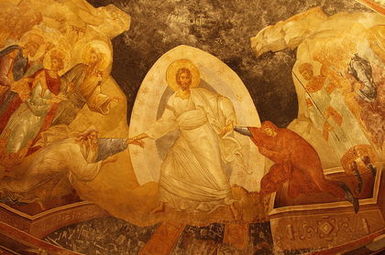
The Great Vigil is the high point, the masterpiece, the center, and the crown of the church year. It happens late at night on the Saturday of Holy Week. It has 4 large pieces:
- The New Fire and the blessing of the Paschal Candle. Just as Christ has come out from the tomb and brought light to the world, so we begin our Vigil with a fire and a tall candle. The candle represents the presence of the risen Lord, and burns at all church services until Pentecost.
- The Prophecies. We sit in the dim church and hear several stories from the Hebrew Scriptures that tell about humanity's creation, its fall, its need for redemption, and God's promises of salvation.
- The Rites of Initiation. The Easter Vigil was and still is the best time for baptisms, because baptism links us together with Christ's dying and rising. Even if there are no candidates for Holy Baptism, the community still blesses the font and renews their baptismal vows.
- The First Eucharist of Easter. After a time of silence, the lights are turned up, the priest announces "Alleluia! Christ is risen!" and the people respond "Christ is risen indeed! Alleluia!" We rejoice and ring bells and celebrate the Holy Eucharist, rejoicing as always that Christ's Resurrection has brought healing to the world